
Why Franchisees are Taking a First Look at the Last Frontier 

For McDonald’s Franchisees willing to consider the far north, Alaska’s remote location and hard winters open doors to opportunity. 

First, some facts: Alaska is far away, the winters are long, and moving goods and people in and out is a challenge.

But those same obstacles are precisely what make Alaska an opportunity. Alaska is a market where demand is high, national competitors are thin on the ground, and operators who do plant a flag are hard to dislodge.

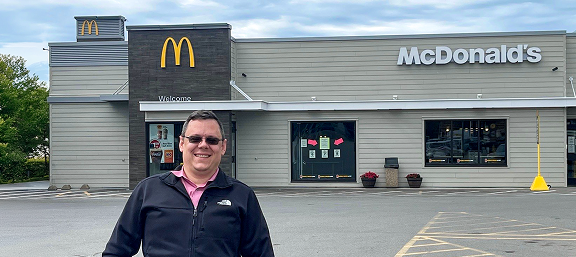
John, a McDonald’s veteran of more than 30 years and now a Franchisee running restaurants on the Kenai Peninsula and in Southeast Alaska, will tell you the state isn’t one market but several and that each one rewards operators willing to do what most won’t.

A market with few competitors

In much of Alaska, fast food isn’t a crowded category.

“If you’re in Homer and you want convenient, affordable food, you’re going to go to McDonald’s,” John says.

That position is hard to overstate.

“People defend us because we’re so involved in the community,” John says. “If a sports team needs shirts, the first people they call is McDonald’s, because we don’t say no.”

"If you’re in Homer and you want convenient, affordable food, 
 you’re going to go to McDonald’s."

-John McDonald, Owner/Operator in Alaska

Demand that dwarfs the population

Alaska has about 739,000 residents. In the most recent year, it hosted more than three million visitors.

Tourism is a $5.6 billion engine for the state, and two-thirds of summer visitors arrive by cruise ship. That demand lands hardest in exactly the kind of small communities where John operates.

Juneau, with a population of under 35,000, sees close to 1.7 million cruise passengers a year. Ketchikan, with about 8,000 residents, is on track for a record 1.6 million in 2026. On a single day, a town that size can absorb 20,000 visitors.

On the Kenai Peninsula, it’s fishing rather than cruise ships. The Kenai River draws hundreds of thousands of anglers each summer to towns of a few thousand people.

For a Franchisee, that means a customer base many times larger than the year-round population for months at a time.

3 million

people visited Alaska in 2025

$5.6 billion

generated by tourism in Alaska annually

20,000+

daily visitors during peak tourism season 

A customer base with money to spend 

Alaskans also bring a few advantages that show up at the register.

The state has no income tax and no statewide sales tax. And every year, the Permanent Fund Dividend pays each eligible resident a share of the state’s oil wealth. In 2025, that was $1,000 paid to more than 600,000 people.

On its own, it’s a small thing. Together, it adds up to a population with more money in its pocket than the headline cost of living might suggest. It’s a windfall that makes its way into local restaurants and retail.

Barriers that keep competition out 

The things that make Alaska hard are the same things that protect the Franchisees already there.

Juneau is the only state capital in the country with no road connection. You reach it by air or by sea. John’s restaurants are spread across markets that, laid over the Lower 48, would stretch from Washington to Ohio.

“We’re literally four different markets,” he says. “What works in Juneau does not work in Anchorage, or vice versa.”

That distance is a moat. The logistics, the shipping, the sheer remoteness keep casual competitors away. And the handful of Franchisees who are there work closely without stepping on each other.

“We’re very autonomous, but we’re pretty close-knit,” John says. “We pick up the phone whenever we need something. If I need help, another operator will say, whatever you need, I’ll send over my people.”

"We’re very autonomous, but we’re pretty close knit. We pick up the phone whenever we need something. If I need help, another operator will say, whatever you need, I’ll send over my people."

-John McDonald, Owner/Operator in Alaska

The system that makes it work

What turns a daunting map into a runnable business is the McDonald’s system itself.

The supply chain, the real estate, the training, the development programs, the parts of Alaska that would severely challenge an independent operator, are the parts McDonald’s is built to handle. John worked through the same training program as everyone else, and later went back to sponsor a class for new Franchisees.

“I’ve looked at other franchisors and other brands,” he says. “Would it still be this world-class, first-class kind of support? I just don’t see it. Folks are with you all the way. If the person working with you doesn’t know the answer, McDonald’s finds somebody who does.”

John is, in some ways, the proof. He grew up outside Fairbanks with no electricity, no running water, an outhouse, and a wood stove in 50-below winters. He started behind a McDonald’s counter at 15.

“I truly have the American dream,” he says. “Had McDonald’s not been there for me, I wouldn’t have it. It was the best thing I’ve ever done.”

Alaska offers what most markets can’t: Demand that outruns the local population, customers who are loyal because you’re the heart of their town, and a system designed to handle everything that makes the place hard. The American dream is alive and well in Alaska.

Explore more growth markets
Mississippi is more than just a business opportunity 

What sets Mississippi apart from other markets? See how affordable operating conditions, community support, and a hospitality-first culture help McDonald s Franchisees grow their business while becoming an integral part of the communities they serve. 

Uncover the vast potential of Upstate New York

Upstate New York combines affordability, opportunity, and support in one thriving market. Franchisees can build their business, develop strong teams, and plan for long term success, making it an ideal environment to build equity and invest in the future. 

Why Franchisees are looking to Duluth

What makes Duluth a smart place to establish a business? Learn why a developing market, strong local support, and the proven McDonald s system is helping operators create successful enterprises while enjoying a high standard of living that’s hard to beat. 

The Greater Portland opportunity

Greater Portland offers the best of both worlds: a thriving economy and an exceptional quality of life. Discover how Franchisees are finding opportunity in a fast-growing market backed by strong community support and the McDonald s system. 

Questions? We have answers.

For US franchising questions, please email us at franchising@us.mcd.com, and a member of our team will get back to you shortly.

For all other questions, check out our Contact Page.


McDonald’s USA, LLC, 110 N. Carpenter St., Chicago, Illinois 60607. Minnesota File No. 10. This information is not intended as an offer to sell, or the solicitation of an offer to buy, a franchise. It is for informational purposes only. U.S. residents: Please note that the states of California, Florida, Hawaii, Illinois, Indiana, Maryland, Michigan, Minnesota, New York, North Dakota, Oregon, Rhode Island, South Dakota, Virginia, Washington, and Wisconsin regulate the offer and sale of franchises. If you are a resident of one of these states, or seeking a franchise in one of these states, we will not offer you a franchise unless and until we have qualified for an exemption, or have complied with applicable pre-sale registration and disclosure requirements in your state. New York residents: This advertisement is not an offering. An offering can only be made by a prospectus filed first with the Department of Law of the State of New York. Such filing does not constitute approval by the Department of Law.

However you want to order, make sure it’s easy

McDelivery Partners
*Must opt-in to Rewards to receive points on eligible purchases in the app. You will not earn points when ordering delivery through this website. To earn points on your delivery order, order McDelivery in the McDonald’s app. Prices for delivery may be higher than at restaurants. Delivery/other fees may apply.